

The North End neighborhood is known by many as Boston’s Little Italy but it wasn’t always this way. The first Italian immigrants arrived in the North End in the 1860s from the Genoa region and the makeup of the neighborhood began to shift from Irish to Italian. The Campanians, Sicilians, Avellinese, Neopolitans, and Abruzzesians all followed the Genoese to the North End and created their own special enclave within the neighborhood.
Italian Immigrants Come to the North End
The influx of Italian immigrants changed the North End in a number of significant ways. St. Leonard’s Church was founded in 1873 and completed at the corner of Hanover and Prince Streets in 1899 to become the first Italian church in Massachusetts and one of the oldest in the country. A new Settlement House Movement also gained momentum in the neighborhood during the same time period to assist immigrants adjusting to life in the city.
Italian immigrants would continue to move to the neighborhood and the population would more than double in a very short time period. By 1930, more than 40,000 Italians were living in an area smaller than one square mile. The neighborhood was more than 99.9% Italian and was thought to be one of the most densely populated neighborhoods in the world.
Best Italian Restaurants in the City
The neighborhood streets soon filled with the aroma of fresh bread, homemade pasta, and strong espresso. Religious festivals, parades, and family-run shops created a close-knit atmosphere that made the North End feel like a “Little Italy” within Boston. Life was not always easy, as many new arrivals faced tough working conditions and crowded housing, but the determination of these families laid the foundation for a neighborhood full of character and resilience.
Italian Influence Today
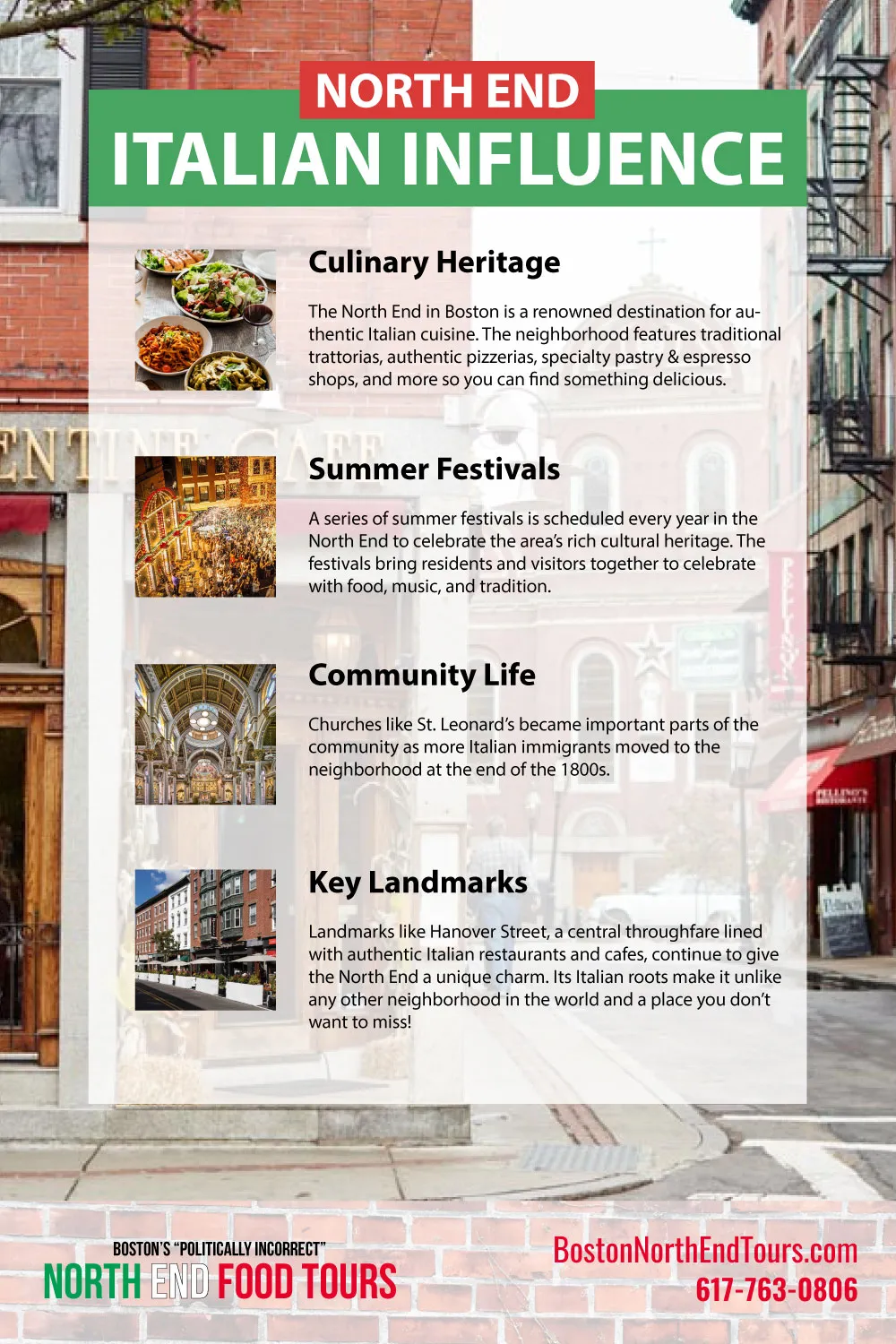
Today, the Italian influence is still unmistakable. Walk down Hanover Street or Salem Street and you’ll find long-standing bakeries, trattorias, and specialty shops that trace their roots back more than a century. Annual celebrations such as the Feast of Saint Anthony continue to bring people together, honoring traditions that began with those early immigrants. While the North End has evolved over time, the legacy of its Italian community remains deeply woven into its identity, shaping the neighborhood’s culture, food, and charm.
Don’t miss your chance to experience Little Italy in Boston with a trip to Boston’s North End. Get a personal look, find hidden gems, and discover a true local experience with a North End Food Tour.